 joyce
Cooking a turkey to perfection means hitting two essential numbers: an oven temperature of 325°F and an internal temperature of 165°F in the thickest part of the thigh. For timing, plan on roughly 25 minutes per pound as your baseline guideline, though oven variability means a reliable meat thermometer is your best friend in the kitchen. Getting turkey right isn’t about guesswork or vague instructions. It’s about understanding the specific temperatures that keep your bird both safe to eat and deliciously moist, plus knowing how cooking time scales with the size of your turkey.
Whether you’re preparing your first Thanksgiving dinner or you’ve roasted dozens of birds over the years, the challenge stays the same: balancing food safety with that perfect golden skin and tender meat. The difference between a dry, overcooked turkey and one that has everyone asking for seconds often comes down to just a few degrees and minutes. We’ve tested these methods in real kitchens with real ovens, because we know that cookbook estimates don’t always match what happens when you open your oven door on the big day.
This guide gives you the concrete numbers you need, weight-based timing charts that take the guesswork out of planning, and the critical checkpoints that ensure your turkey is safe and spectacular every time.
What You’ll Need Before You Start
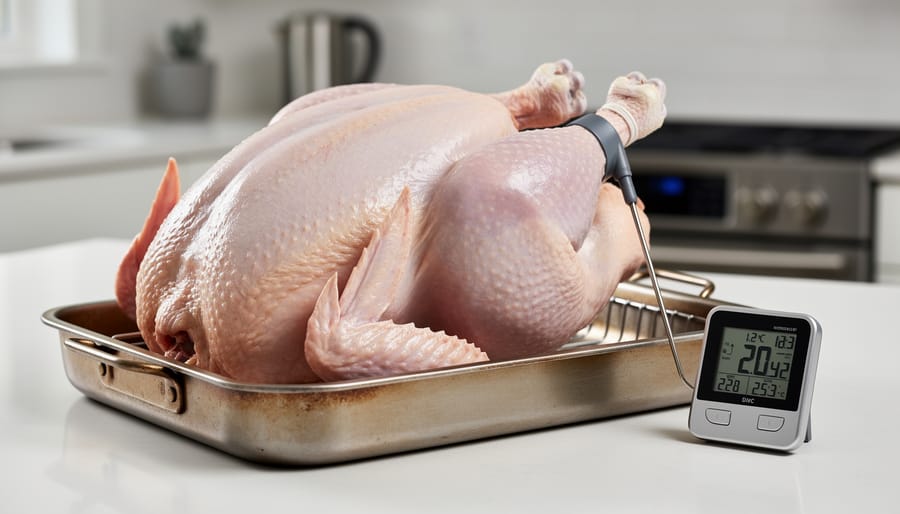
Getting your turkey right starts before you turn on the oven. Having the proper roasting tools isn’t just convenient; it’s essential for food safety and consistently good results.
Here’s what you actually need:
- Meat thermometer: The only reliable way to confirm your turkey reaches the safe 165°F internal temperature, since ovens vary wildly
- Roasting pan with rack: Elevates the bird so hot air circulates underneath for even cooking
- Kitchen twine: Keeps the legs tucked in for uniform cooking and a prettier presentation
- Aluminum foil: Tents over the breast if it’s browning too fast while the thighs catch up
- Basting tools: A bulb baster or large spoon to redistribute pan juices for moist meat
The meat thermometer deserves special emphasis. Cooking times shift based on whether you have a conventional or convection oven, how accurate your temperature dial is, and even how often you open the door. Time estimates like 25 minutes per pound give you a ballpark, but the thermometer tells you the truth. You can’t eyeball doneness with poultry, and undercooked turkey isn’t just disappointing; it’s a genuine health risk.
If you don’t own a reliable thermometer yet, get one before turkey day. It’s the difference between guessing and knowing your bird is perfectly cooked.
Safety First: Critical Temperature Rules
Getting the temperature right isn’t just about a better-tasting bird, it’s about keeping your family safe. Before you even turn on the oven, make sure your turkey is completely thawed. A partially frozen turkey won’t cook evenly, leaving dangerous cold spots where bacteria can survive.
Never cook your turkey below 325°F. Lower temperatures don’t heat the meat quickly enough to prevent bacterial growth, turning what should be a celebration into a food safety risk. This minimum temperature is non-negotiable, regardless of what alternative methods you might see online.
Here’s the critical point many home cooks miss: oven cooking times vary significantly depending on your specific oven. Two identical turkeys cooked in different ovens at the same temperature can finish 30-45 minutes apart. Calibration differences, hot spots, and whether you have a convection oven all affect timing. Convection ovens circulate hot air, cooking your turkey faster than conventional ovens at the same temperature setting.
This is why relying solely on time calculations is risky. The 25-minutes-per-pound guideline gives you a starting estimate, but your meat thermometer tells you the truth. Check the internal temperature in multiple spots, the innermost part of the thigh and the thickest part of the breast, to ensure your entire turkey has reached that critical 165°F threshold.
Turkey Cooking Times and Temperatures: The Core Method
The straightforward path to perfectly cooked turkey starts with two numbers: 325°F in your oven and about 25 minutes per pound as your timing baseline. This combination delivers consistent results across different turkey sizes and oven types, which is why it’s become the gold standard for home cooks.
Here’s how it works in practice. A 12-pound turkey needs roughly 5 hours at 325°F, while a 16-pounder requires closer to 6.5 hours. These estimates give you a reliable starting point when you calculate time per pound but remember that your meat thermometer has the final say. Oven variations mean the actual cooking time might land 30 minutes on either side of your estimate.
Why does this method work so well? The moderate heat allows the turkey to cook evenly from exterior to interior without drying out the breast meat before the thighs reach safe temperature. You’re not racing against browning or managing dramatic temperature shifts, which makes the whole process more forgiving.
Yes, alternative approaches exist. The high-heat start method begins at 500°F for 30 minutes before dropping to 350°F, which can shave time off the total cook. But that technique demands closer attention and introduces more variables. For your first few turkeys, or when you’re juggling multiple dishes on a busy holiday, the steady 325°F method removes guesswork and delivers reliably moist results.
The key insight? These time estimates are your roadmap, not your destination. Your thermometer reading 165°F in the thickest part of the thigh tells you when the turkey is actually done.
Step-by-Step: How to Cook Your Turkey
Preparing the Bird
Start by confirming your turkey is completely thawed, no icy patches in the cavity or on the surface. A partially frozen bird throws off all timing calculations and cooks unevenly. Reach inside and pull out the giblet packet and neck; they’re usually tucked in the main cavity or the neck opening. Pat the entire turkey dry with paper towels, inside and out. This step matters more than most cooks realize, moisture on the skin prevents browning and creates steam instead of that golden, crispy finish you’re after.
Season the turkey however you prefer, keeping it simple or going bold. Rub softened butter or oil over the skin, then add salt, pepper, and any herbs or spices you like. For our step-by-step turkey approach, less fussing often yields better results.
Place the bird breast-side up on a rack inside your roasting pan. The rack lifts the turkey off the pan bottom, allowing heat to circulate underneath and preventing the underside from steaming in its own juices. Tuck the wing tips under the body, they brown too quickly otherwise, and tie the legs together loosely with kitchen twine if you want a neater presentation.
During the Roasting Process
Once your turkey is in the oven, checking the temperature early and often is your best strategy. Insert your meat thermometer into the thickest part of the thigh (avoiding bone) about halfway through the estimated cooking time, then check every 30 minutes as you approach doneness. The thigh should reach 165°F minimum.
If the breast or top is browning too quickly while the thigh is still under temperature, tent the turkey loosely with aluminum foil. This slows down surface browning and gives the thicker meat time to catch up. You can remove the foil during the last 30 minutes if you want the skin to crisp up.
Oven type makes a real difference in timing. Convection ovens circulate hot air constantly, cooking turkey faster than conventional ovens at the same temperature setting. If you’re using convection, start checking temperature earlier than the 25-minutes-per-pound guideline suggests. Traditional ovens vary more in their actual temperature, which is why the thermometer matters more than the clock. Your goal is always 165°F internal temperature, regardless of how long it takes to get there.
The Critical Rest Period
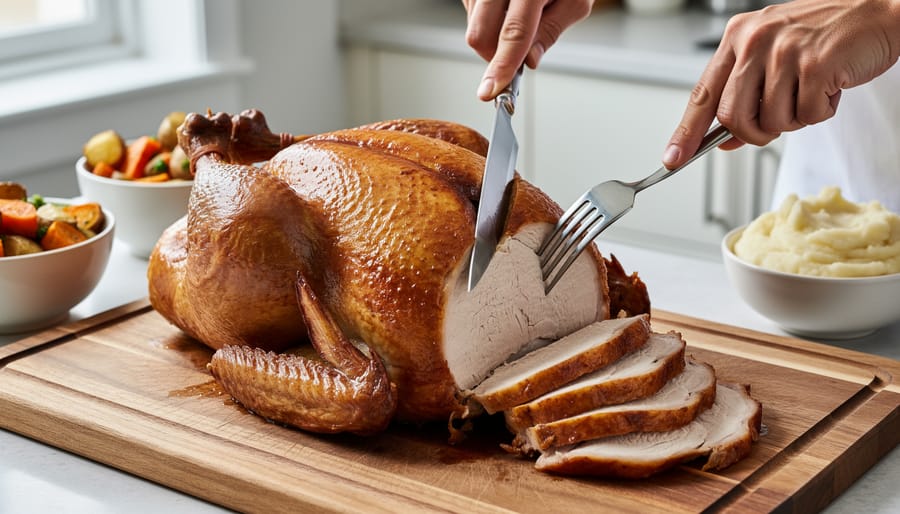
Once your turkey reaches 165°F, resist the urge to carve immediately. Resting for 30-45 minutes allows the juices to redistribute throughout the meat instead of spilling onto your cutting board. During this time, carryover cooking continues, with the internal temperature rising a few degrees even after you remove the bird from the oven. This rest period makes carving significantly easier since the meat firms up slightly, and you’ll notice the difference in every slice: moist, tender turkey instead of dry edges and a puddle of lost juices. Tent the bird loosely with foil if your kitchen is cool, but don’t wrap it tightly or you’ll steam the crispy skin you worked hard to achieve.
How to Know When Your Turkey Is Done
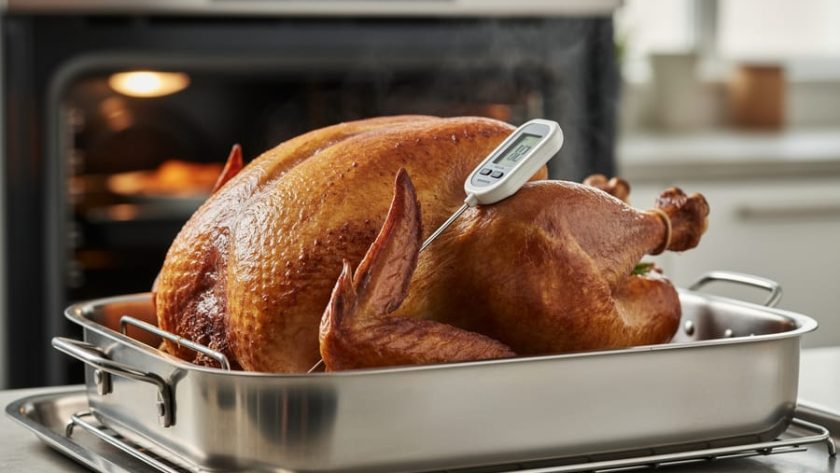
The only way to know your turkey is truly done is to check its internal temperature with a meat thermometer. Insert the thermometer into the thickest part of the thigh without touching bone, and look for a reading of 165°F or higher. That’s your magic number, and it’s non-negotiable for food safety.
Don’t rely on visual cues alone. A golden-brown skin or clear juices can be misleading since browning happens at different rates depending on your oven and how you’ve prepared the bird. Similarly, cooking timers are helpful guides, but they can’t account for the reality that oven cooking times vary significantly based on your appliance, the turkey’s exact shape, and whether you’re using convection heat. Your thermometer tells the truth every time, which is why it’s the only tool that matters when you’re making the final call on doneness.
Common Questions About Turkey Cooking Times
Here’s a question that comes up in my inbox every holiday season: “Can I cook a turkey at a higher temperature to speed things up?” The short answer is yes, but it requires careful attention. While the safe minimum is 325°F, you can use methods like starting at 500°F for 30 minutes before dropping to 350°F. These higher-heat approaches can work, but they demand more vigilance to prevent over-browning and uneven cooking. For most home cooks, sticking with 325°F and the 25-minutes-per-pound guideline offers more forgiving, consistent results.
What if I have a convection oven?
Convection ovens circulate air and cook faster than conventional ovens, so reduce your estimated cooking time by about 25% and monitor the internal temperature closely to avoid overcooking.
Can I cook turkey breast from frozen?
Yes, you can cook frozen turkey, but it will take about 50% longer than the standard timing, and you won’t be able to season the cavity or remove the giblets until partway through cooking.
Why does my turkey cook faster or slower than the chart says?
Oven temperatures vary significantly between models, pan material affects heat distribution, and factors like stuffing, starting temperature, and even turkey shape all influence actual cooking time. This is why a meat thermometer is essential.
Do I need to baste my turkey?
Basting isn’t necessary for safety or moisture, and opening the oven repeatedly can extend cooking time, but it does promote even browning and adds flavor if you’re using seasoned drippings.
Another common concern is what to do when your turkey is cooking much slower than expected. First, verify your oven temperature with an oven thermometer since many ovens run 25 degrees cooler than the dial indicates. Check that your roasting pan isn’t blocking heat circulation, and make sure the turkey started fully thawed. If everything checks out but timing still seems off, simply trust your meat thermometer over the clock. The bird is done when it hits 165°F in the thickest part of the thigh, period.
And here’s something that surprises people: you don’t need to stress if your turkey reaches temperature a bit early. Once it hits 165°F, tent it loosely with foil and let it rest for the full 30-45 minutes. The meat will stay hot, finish redistributing its juices, and be far easier to carve than if you rushed straight from oven to table.
With these three fundamentals locked in, 325°F oven temperature, roughly 25 minutes per pound as your planning guide, and 165°F internal temperature as your finish line, you’ve got everything you need to cook turkey with confidence. Remember that your thermometer tells the truth while the clock just estimates, and you’ll never second-guess whether dinner’s ready.
I’d love to hear how your turkey turns out. Drop a comment below with your results, any challenges you faced, or questions about your specific situation. Every oven behaves a bit differently, and sharing what works (or what doesn’t) helps the whole community cook better. That’s what we’re here for, tested methods, real support, and making sure your holiday centerpiece turns out beautifully every single time.