 joyce
A 5 kg turkey (about 11 pounds) needs 2 hours and 45 minutes to 3 hours and 15 minutes in a 325°F oven when unstuffed, or 3 hours to 3 hours and 40 minutes when stuffed. The bird is safe to eat when a meat thermometer inserted into the thickest part of the breast reads 165°F. Whether you’re hosting your first holiday dinner or just need a quick timing check while prepping your meal, getting this right means the difference between a juicy centerpiece and a dry disappointment.
We’ve tested dozens of turkeys in our kitchen, and the single most important lesson is this: your thermometer matters more than your timer. Oven temperatures vary, turkey shapes differ, and a cold bird straight from the fridge cooks slower than one at room temperature. The cooking times above give you a solid starting point for planning your day, but that 165°F internal temperature is your true finish line.
This guide walks you through everything you need to know about roasting a 5 kg turkey successfully. You’ll get a reference chart for quick timing, the essential tools that make the job easier, safety steps you can’t skip, and a detailed process from prep to carving. We’ve also answered the questions that come up most often in our readers’ kitchens, like whether you can speed things up at a higher temperature or how to tell if your turkey is done without cutting into it.
5 Kg Turkey Cooking Time: Quick Reference Chart
A 5 kg turkey weighs approximately 11 pounds, which gives you a reliable starting point for planning your roasting schedule. At the recommended 325°F oven temperature, you’re looking at roughly 2.5 to 3.5 hours of cooking time, depending on whether your bird is stuffed.
For an unstuffed 5 kg turkey, expect 13 to 15 minutes per pound. That translates to about 2.5 to 3 hours total in the oven. If you’ve decided to stuff your turkey, add extra time: 15 to 20 minutes per pound, which means 3 to 3.5 hours for the same size bird. Turkey roasting times at 325°F follow these per-pound guidelines consistently across most cooking references.
Here’s the practical breakdown for a 5 kg (11 lb) turkey at 325°F:
Unstuffed: 2.5 to 3 hours
Stuffed: 3 to 3.5 hours
These times are your guide, not a guarantee. Every oven runs a bit differently, and factors like starting temperature, roasting pan type, and even how often you open the oven door can shift the timeline. That’s why timing alone won’t tell you when your turkey is truly ready.
The only reliable measure of doneness is internal temperature. Your turkey must reach 165°F in the thickest part of the breast, the innermost part of the thigh, and the wing joint. Use these time estimates to plan your day and start checking temperature about an hour before the lower end of the range. Trust your thermometer, not the clock.
What You’ll Need to Cook Your Turkey Safely
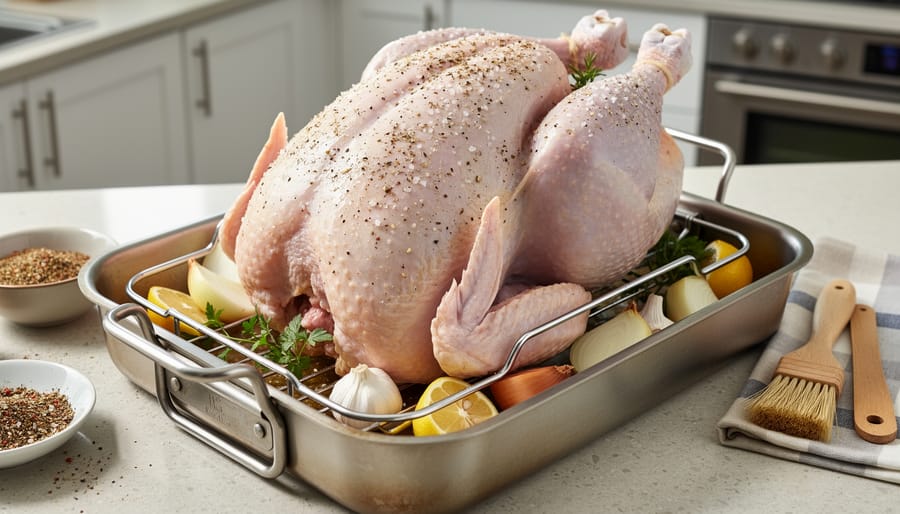
Before you start cooking, gather these essential tools. Having everything ready makes the process smoother and helps you avoid scrambling mid-roast when your hands are full and the oven is hot.
- Meat thermometer, the single most important tool for food safety, ensuring your turkey reaches 165°F internally
- Roasting pan with a rack, keeps the turkey elevated for even heat circulation and prevents the bottom from getting soggy
- Aluminum foil, protects the breast from over-browning and helps retain moisture during roasting
- Basting brush or large spoon, for keeping the skin golden and the meat juicy throughout cooking
- Heavy-duty oven mitts, essential for safely handling a hot, heavy roasting pan
The meat thermometer deserves special mention because timing alone won’t guarantee a safe turkey. A 5 kg bird might cook faster or slower depending on your oven, the turkey’s starting temperature, and whether it’s stuffed. The thermometer removes the guesswork and prevents both undercooking (a serious food safety risk) and overcooking (which dries out your hard work). If you’re investing in the best cooking equipment for your kitchen, an instant-read digital thermometer should top your list.
Take a minute to check that your thermometer works and your roasting pan fits comfortably in your oven. These small preparations now save you stress later and help ensure your turkey turns out beautifully cooked and perfectly safe to serve.
Important Safety Warnings Before You Start
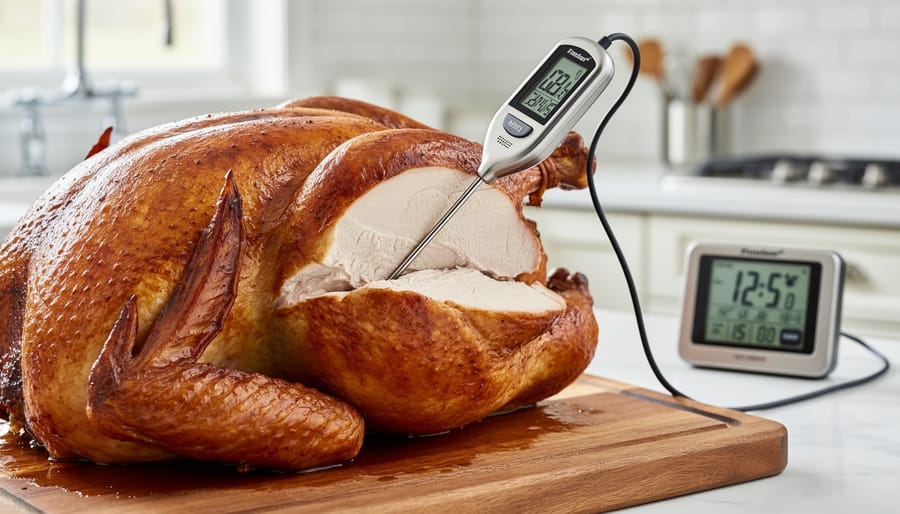
Before you start cooking, understanding a few critical safety points will protect both your health and your holiday meal. These aren’t optional extras, they’re essential practices every home cook needs to follow.
Your turkey must reach an internal temperature of 165°F in three places: the thickest part of the breast, the innermost part of the thigh, and the thickest part of the wing. This temperature kills harmful bacteria like salmonella that can cause serious food poisoning. Never rely on cooking time alone to determine doneness. A 5 kg turkey might cook faster or slower than expected depending on your oven, the bird’s starting temperature, and whether it’s stuffed.
Understanding carryover cooking can help you avoid a dry turkey while staying safe. When you remove the bird from the oven, its internal temperature continues to rise by about 5 degrees as the heat redistributes. Many experienced cooks pull their turkey at 160°F, knowing it will coast to 165°F during rest. If you’re new to this technique, stick with the full 165°F until you’re comfortable.
Finally, respect the heat. Use sturdy oven mitts when handling your roasting pan, a 5 kg turkey plus pan and drippings is heavy and awkward. Keep children and pets away from the oven, and make sure your workspace is clear before you lift that hot pan out.
Step-by-Step: Cooking Your 5 Kg Turkey to Perfection
Preheat and Prepare
Start by setting your oven to 325°F and giving it at least 20 minutes to reach the full temperature before the turkey goes in. While it heats, remove your 5 kg turkey from the refrigerator and take off any packaging, giblets, and neck from the cavity. Pat the bird completely dry with paper towels, moisture on the skin prevents proper browning.
Place the turkey breast-side up on a rack in your roasting pan. If you like, tuck the wing tips under the body and loosely tie the legs together with kitchen twine, though this step is optional. Rub the entire surface lightly with softened butter or a neutral oil to encourage golden, crispy skin. Your turkey is now ready for the oven.
Calculate Your Cooking Time
A 5 kg turkey weighs approximately 11 pounds, so you can calculate per pound using the standard guidelines. For an unstuffed bird, multiply 11 pounds by 13 to 15 minutes per pound, that gives you roughly 2 hours and 23 minutes to 2 hours and 45 minutes. If you’re cooking a stuffed turkey, use 15 to 20 minutes per pound instead, which works out to about 2 hours and 45 minutes to 3 hours and 40 minutes.
Write these times down before you start, but remember they’re estimates. Your oven’s quirks, the turkey’s starting temperature, and how often you open the door all affect the final cooking time. That’s why you’ll want to start checking the internal temperature during the last hour of roasting rather than relying solely on the clock.
Roast and Monitor
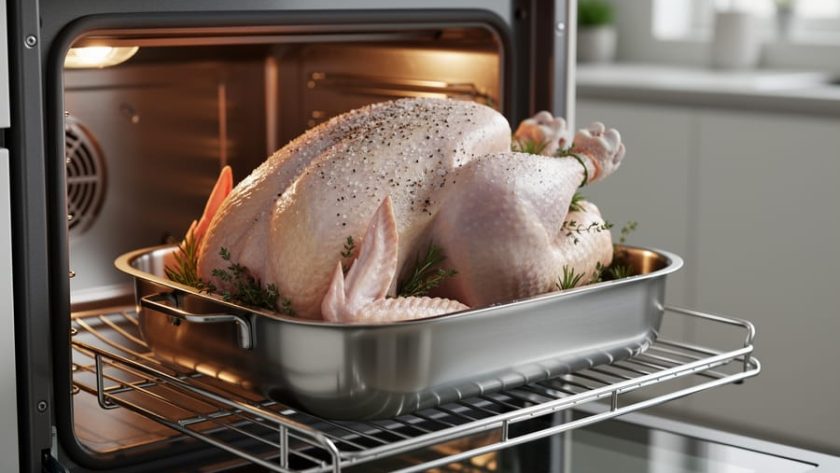
Place your turkey in the oven and roast according to your calculated time. You don’t need to baste constantly, every 45 minutes to an hour is plenty if you choose to do it at all. Many cooks skip basting entirely without sacrificing moisture, so don’t stress if you’d rather leave the oven closed.
Keep an eye on the skin color as your turkey roasts. If the breast or wings start browning too quickly, usually after the first hour or two, loosely tent those areas with aluminum foil. This protects the skin while the interior continues cooking. You can remove the foil in the final 30 minutes if you want a deeper golden finish.
About an hour before your estimated finish time, start checking the internal temperature with your meat thermometer. Insert it into the thickest part of the breast and thigh without touching bone. You’re looking for 165°F, though pulling the bird at 160°F accounts for carryover cooking as the temperature rises while it rests.
For more detailed guidance on the entire roasting process, check out our step-by-step turkey oven guide.
Check for Doneness with a Thermometer
About an hour before your calculated cooking time is up, grab your meat thermometer, it’s time to check for doneness. Insert the probe into the thickest part of the breast without touching bone, then check the innermost part of the thigh and the thickest section of the wing. You’re looking for 165°F in all three spots. This temperature ensures your turkey is safe to eat and perfectly cooked.
Here’s a helpful tip: turkey continues cooking even after you remove it from the oven, a process called carryover cooking. If you pull your bird out when it hits 160°F, the internal temperature will climb those final five degrees while it sits. This approach can help you avoid overcooking, especially in the breast meat.
Don’t rush this step. Take your time with each reading, and if any spot hasn’t reached temperature yet, pop the turkey back in the oven and check again in fifteen minutes. The thermometer never lies, and it’s your best friend for a safe, delicious result.
How to Know Your Turkey Is Perfectly Cooked
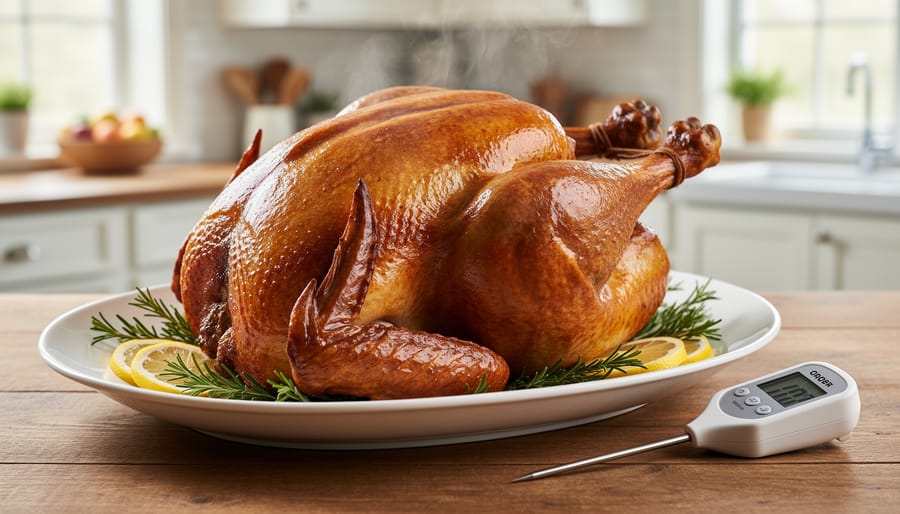
The most reliable sign that your turkey is perfectly cooked is an internal temperature of 165°F in the thickest part of the breast, thigh, and wing. Your meat thermometer doesn’t lie, this single reading tells you more than any other indicator combined.
Beyond the temperature check, look for clear juices when you pierce the thigh. If the liquid runs pink, the turkey needs more time. Fully cooked turkey releases juices that are clear or pale yellow, not bloody or cloudy. The meat should feel firm to the touch, not squishy or overly soft.
A beautifully cooked turkey also displays golden-brown, crisp skin. While this looks impressive and tastes wonderful, it’s purely aesthetic, appearance alone can’t confirm safety. I’ve seen gorgeous birds that were still raw inside and pale ones that were perfectly done.
Here’s where many cooks second-guess themselves: trust your thermometer over everything else. Timing charts are guides, not guarantees. Your oven may run hot or cool, your turkey may have been colder than expected, or airflow in your roasting pan might affect cooking speed. When that thermometer hits 165°F in all three spots, your turkey is safe to eat, regardless of how long it took or how it looks.
Common Questions About Cooking a 5 Kg Turkey
Cooking a 5 kg turkey raises a lot of questions, especially if it’s your first time or you’re adapting familiar methods to a different bird size. Here are answers to the most common concerns we hear from readers.
How long does it take to cook turkey per kilogram?
A good rule of thumb is about 45 minutes per kilogram at 325°F for an unstuffed turkey. For a 5 kg bird, that works out to roughly 3.5 to 4 hours, though the exact time depends on your oven and whether the turkey is stuffed.
What if I don’t have a meat thermometer?
A thermometer is the only reliable way to confirm your turkey has reached the safe internal temperature of 165°F. If you don’t have one, pick one up before cooking, it’s an inexpensive tool that ensures food safety and prevents guesswork.
Can I cook my turkey at a higher temperature to save time?
While you can roast at higher temperatures, 325°F is the sweet spot for even cooking and juicy meat. Rushing at higher heat often leads to dry breast meat or unevenly cooked thighs, so patience pays off.
Why does my turkey cook faster or slower than expected?
Oven calibration, turkey shape, starting temperature, and whether it’s stuffed all affect cooking time. This is why internal temperature matters more than the clock, every turkey is different.
Another question we get is whether to cover the turkey with foil. If your bird is browning too quickly, tenting it loosely with aluminum foil helps prevent burning while the inside finishes cooking. Remove the foil in the final 30 minutes for crispy, golden skin.
If you’re working with a smaller cut, you might find our guide on how to cook turkey breast from frozen helpful for quicker weeknight meals.
Have a question we didn’t cover? Drop it in the comments, we love hearing from you and helping troubleshoot your turkey challenges.
Your 5 kg turkey will take roughly 3.5 to 4 hours at 325°F, but remember: the clock is just a guide. Your meat thermometer is the real hero here. When it reads 165°F in the thickest part of the breast, thigh, and wing, you’re done. Trust that reading, take a breath, and celebrate what you’ve accomplished. You just roasted a beautiful turkey! If you ran into any surprises or want to share how it turned out, drop a comment below. We’d love to hear from you. And if you’re hungry for more turkey know-how, explore our other recipes and holiday cooking tips. You’ve got this, and we’re here to help every step of the way. Happy cooking!